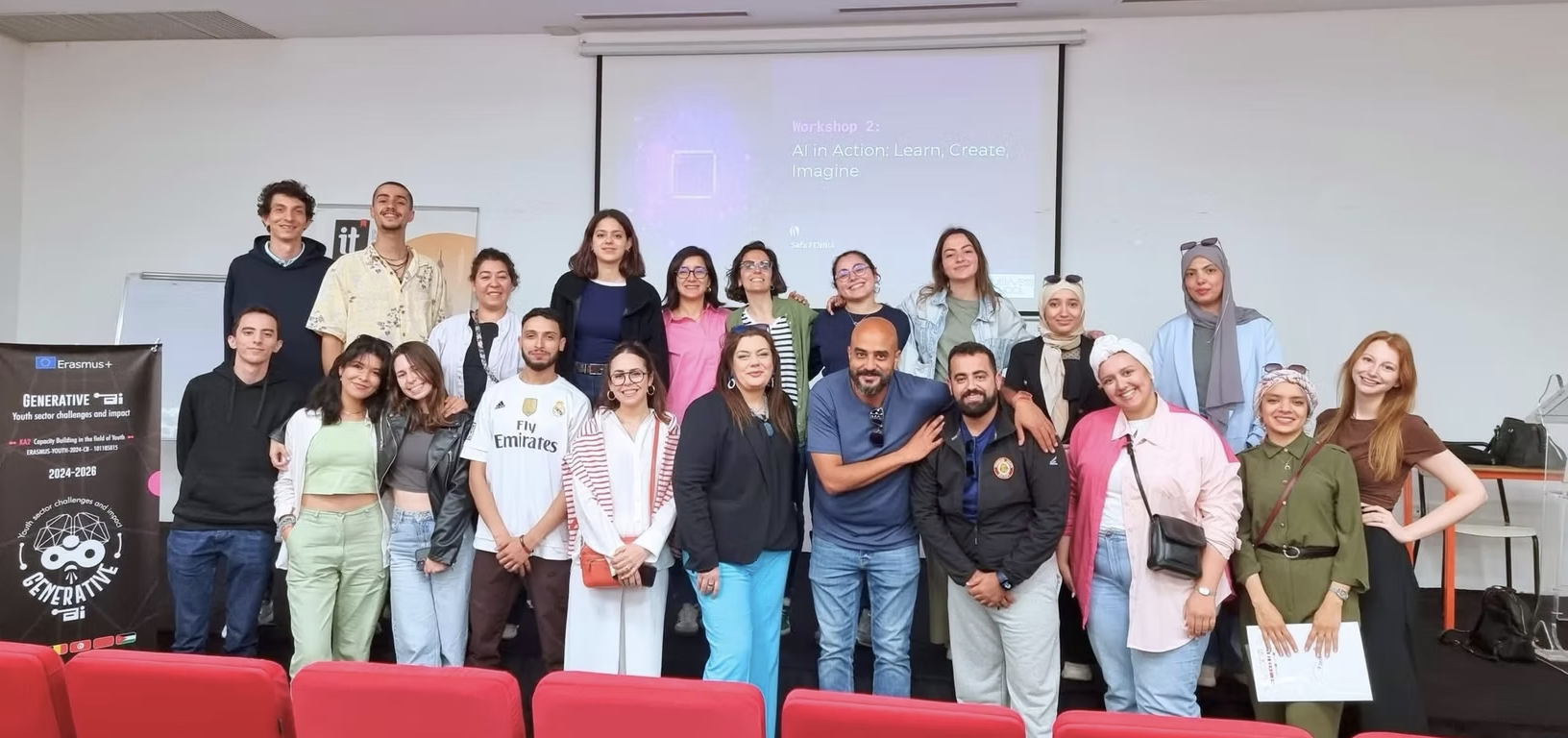
Hammamet, Tunisia — On the shores of the Mediterranean, a new vision began to take shape: artificial intelligence, often perceived as a source of division and risk, can become an effective tool for promoting social inclusion, developing critical thinking, and strengthening social responsibility. This vision came to life during the training course organised as part of the “Generative AI – Youth Sector Challenges and Impact” project, implemented under the Erasmus+ programme and hosted by EuroMed EVE Tunisia, with the participation of young people from across the Euro-Mediterranean region.
This experience was more than a technical training course. It represented a pivotal milestone in the project's journey, as strategic ideas moved from the planning stage into practical implementation. The meeting provided a space for collective reflection, experimentation, and collaboration around a central question: How can generative artificial intelligence be used ethically to combat hate speech and strengthen democratic values?
Throughout the training, participants deepened their understanding of how artificial intelligence systems work, how digital narratives shape public opinion, and how technology affects social cohesion. Particular attention was also given to ethical considerations, including bias, accountability, and the societal implications of digital innovation. These discussions helped participants develop a balanced critical awareness that combines technical competence with human values.
What made the Hammamet experience particularly distinctive was its emphasis on creativity and collective intelligence. Participants were encouraged to move beyond the role of passive recipients and become active contributors by developing ideas, testing solutions, and imagining an alternative digital future built on empathy and mutual respect. The intercultural exchange also helped participants recognise that diversity of perspectives is not an obstacle to innovation but one of its greatest strengths.
As this training milestone came to an end, participants left with not only enhanced digital skills but also a renewed sense of responsibility and social purpose. They emerged as more informed digital citizens, better equipped to identify manipulative content, resist online toxicity, and contribute to the spread of positive narratives within their communities. In this way, the Hammamet experience strengthened a growing regional network of young people committed to harnessing artificial intelligence for the common good rather than allowing it to reinforce division.
In a world increasingly shaped by algorithms and automated content, this experience conveyed a clear message: technology alone does not determine the future; people shape it. When young people are empowered with knowledge and innovation is guided by values, artificial intelligence can become a bridge towards mutual understanding rather than a tool for polarisation.
Here’s a glimpse of what we did over 5 dynamic days:
Day 1 – Kick-off & AI Basics
👋 Welcome session
🧠 Interactive workshop to demystify AI
⚖️ Talk on AI’s role in hate speech
🎭 Role play: “AI Debate”
Day 2 – AI in Action
💻 Expert-led AI Masterclass by university professors from the IT Business School of Nabeul
🛠️ Hands-on sessions with real AI tools
Day 3 – Ethics & Creativity
💡 Exploring AI for Good
🕵️ “Unravelling AI” workshop
🚀 Scenario Sprint: building real-world solutions
Day 4 – AI Meets Storytelling
✍️ Crafting narratives around AI
🎬 Learning to use AI storytelling tools
Day 5 – Planning for Impact
🌍 Mapping needs & stakeholders
📊 Designing strategies for real-world application
🎉 Closing session filled with ideas & connections
We leave inspired, empowered, and ready to shape the future with AI – for good!