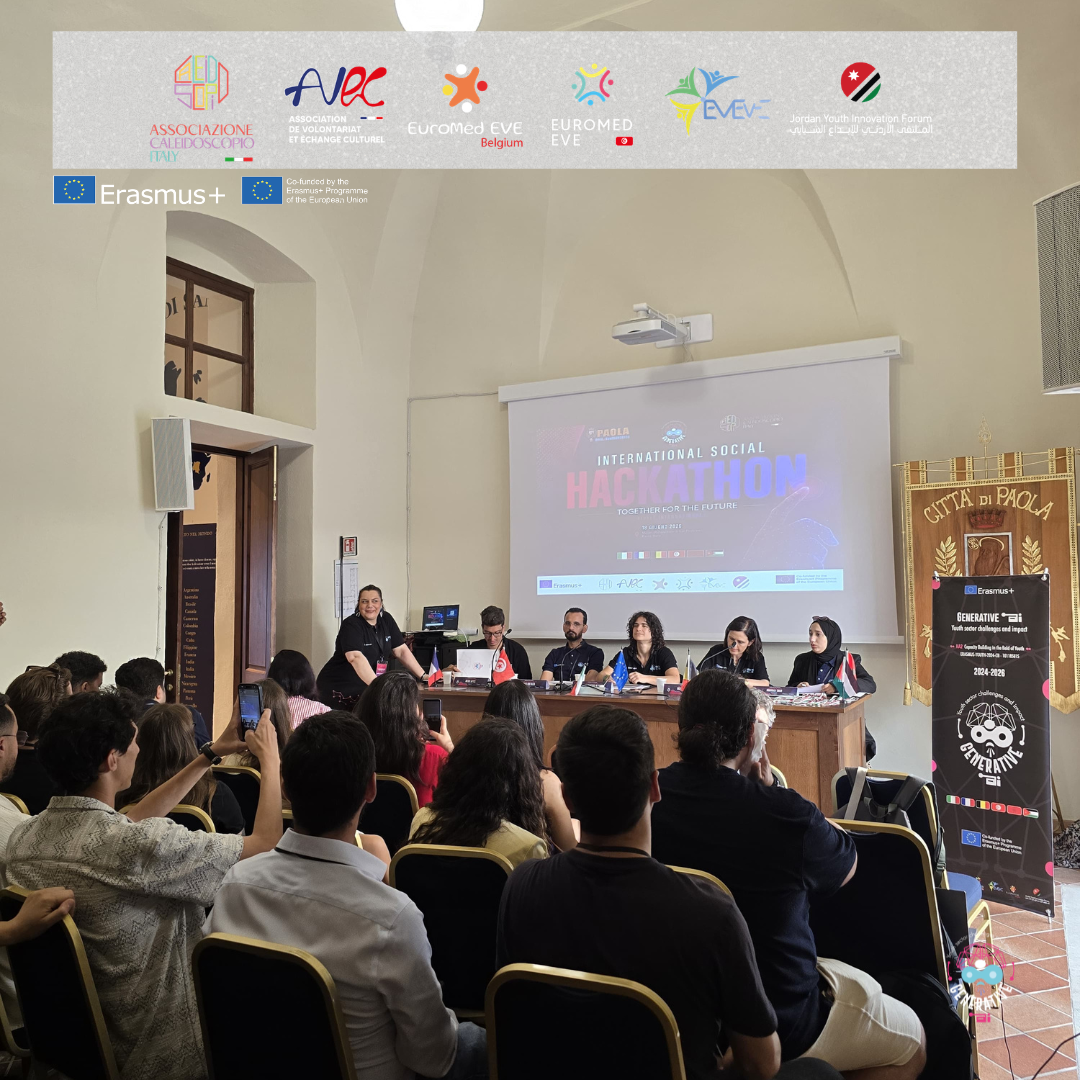
On 18 June 2026, young people from six countries gathered in Paola, Italy, for the international final of "Together for the Future," a social hackathon on how artificial intelligence can make the internet safer and more inclusive.
The programme behind the event
The hackathon is part of Generative AI – Youth Sector Challenges and Impact, a 24-month project funded under Erasmus+, the European Union's programme for education, training, youth and sport. It falls under the Capacity Building in the field of Youth action, which supports cooperation between youth organisations in Europe and partner countries beyond the EU.
The project aims to equip NGOs, youth workers and young people with the digital and critical skills needed in an AI-driven society. Its focus is clear: countering online hate speech and misinformation, and promoting respect, inclusion and democratic participation.
The consortium brings together six organisations from both shores of the Mediterranean: Caleidoscopio Association in Italy as coordinator, AVEC in France, EUROMED EVE in Belgium, Tunisia and Morocco, and the Jordan Youth Innovation Forum in Jordan.
A two-year journey
Paola was the final stop of a long process. Over two years, the project combined research, local activities and international training courses in Hammamet and Paris, along with a mid-term meeting in Marrakech. It also produced AHAPP, a mobile app designed to raise awareness and support young people and youth workers facing digital harm.
Before the final, each partner country organised a three-month National Social Hackathon. Youth workers, students, educators and professionals worked in teams, supported by mentors and training workshops, to design AI-based solutions to hate speech, misinformation and online exclusion. One team per country was selected to compete in Italy.
The final in Paola
The international final brought together 38 participants, including young people, mentors, partners and experts. Each national team presented its solution to an international jury, which evaluated the projects on innovation, feasibility and social impact.
Teams did more than pitch ideas. They had to research the problem, design a solution and turn it into a working prototype, which meant long hours, constant testing and close collaboration with people from different countries and backgrounds.
Kindness Filter: the Moroccan project
The Moroccan team presented Kindness Filter, a browser tool that analyses text as the user types, detects harmful language and suggests a more respectful alternative before the message is sent.
The idea is based on a simple observation: many harmful messages are written in a moment of anger. By creating a short pause and offering a better choice of words, Kindness Filter aims to prevent harm rather than react to it afterwards.
Results
The projects covered a wide range of approaches, from moderation tools to educational solutions and safer online spaces for young people. The host country was represented by the team Digital Conscience with SafeSpace AI.
After careful deliberation, the jury announced the final ranking:
-
Tunisia
-
Morocco
-
Italy
Beyond the competition
For many participants, the most valuable outcome was not the ranking but the experience itself. Young people, mentors and experts from different cultures worked side by side on a shared problem, exchanged ideas openly and learned from each other's perspectives.
This is the spirit of Erasmus+: building skills while building connections between people and communities.
Acknowledgements
We thank the organisers, mentors, jury members and partners who made the event possible, and every participant for their commitment. Special thanks go to the city of Paola for its warm hospitality.
This project is co-funded by the European Union under the Erasmus+ programme. The views expressed are those of the authors and do not necessarily reflect those of the European Union.